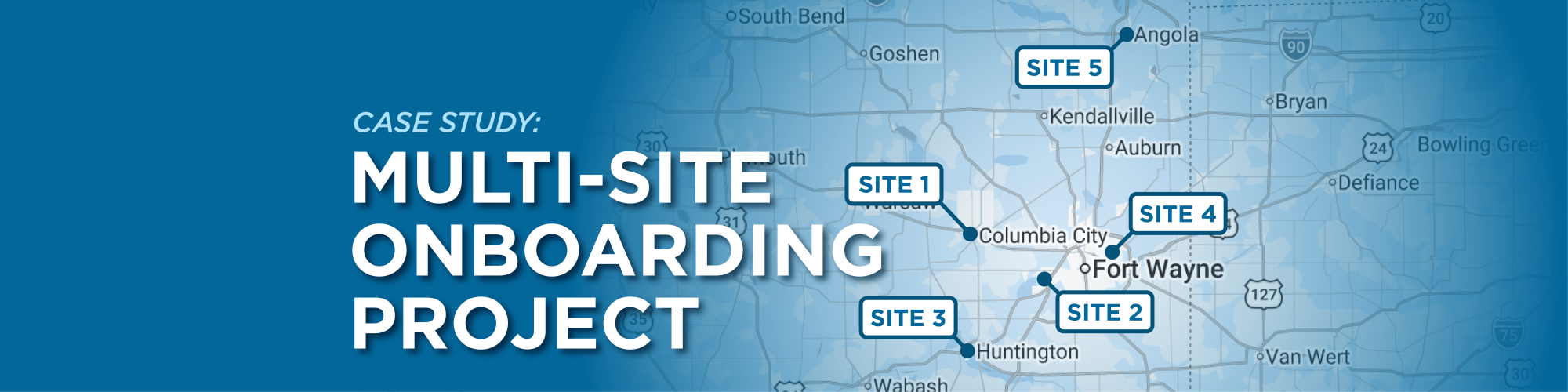
The challenge: An autism center operating across five locations needed to transition to a new IT provider quickly, with minimal disruption to staff, and Nexus inherited a backlog of unresolved issues from their previous provider.
The solution: A rapid, parallel onboarding process with full network segmentation, security hardening, and infrastructure reconfiguration across all five sites, completed in two weeks.
The outcome: The client now has a secure, properly documented IT infrastructure, a fully staffed helpdesk, and an IT partner capable of handling everything from network management to day-to-day support requests.
Recently, Nexus Technology Partners was approached by an autism center for children to take over IT services from their existing provider. The center operates across five locations and serves a sensitive population, making reliable, secure technology essential to their daily operations.
The client's previous IT provider had left them with slow response times, chronic unresolved issues, and a network infrastructure that had not been maintained to current standards. Staff were unable to get timely help, and IT problems regularly disrupted their ability to do their jobs. One employee had waited over a week and a half for a laptop issue to be addressed, and the day the previous provider was finally scheduled to come out, they canceled. Nexus resolved the same issue remotely in 15 minutes!
The Challenge: A Compressed Timeline and an Inherited Mess
A standard onboarding of this scope typically takes two months. Due to delays in receiving documentation and system access from the outgoing provider, Nexus had just two weeks to complete the transition.
What awaited us was significant. The networks across all five locations had never been properly organized. Staff computers, guest Wi-Fi, printers, cameras, and everything else were all running on the same unsegmented network, meaning a visitor connecting to the guest Wi-Fi could potentially access the same network as employees. Printers and security cameras were frequently unreachable because of configuration issues that had accumulated over time. The client had even lost access to their own domain name, the address that ties together their website and email, as it had not been properly transferred during previous provider changes. On top of all of this, there were 14 open support tickets that needed to be addressed, which Nexus would need to work through at the same time as the onboarding.
Solution: Parallel Execution Across Five Sites
To meet the deadline, the Nexus team divided responsibilities by site. Each team member took ownership of individual locations, configuring routers, switches, and network infrastructure in parallel, then cross-referencing and consolidating configurations across the team.
Key work completed during the two-week window included:
Separating and securing the network.
Nexus reorganized the network at every location so that guest Wi-Fi, staff devices, and operational systems like printers and cameras each operated in their own isolated space. This means a guest connecting to the Wi-Fi at any location can no longer see or interact with internal systems. Guest networks were also set up with speed limits and content filtering, an added layer of protection given that children at the center occasionally use computers on-site.
Getting devices working reliably.
Configuration errors were corrected across printers and security camera systems that had been randomly dropping off the network. After the fix, staff could count on these devices being available consistently.
Recovering the client's own accounts.
Nexus tracked down and regained access to the client's domain name, which controls their website and email, as well as their Microsoft accounts, ensuring the organization had full ownership and control of their digital assets going forward.
Working with existing equipment.
Rather than replacing the client's networking hardware before its lease was up, Nexus found a way to manage and improve it using the tools already in place. This meant the client didn't have to absorb unnecessary hardware costs mid-contract.
All physical installations were completed after hours so that staff experienced no disruption. Employees arrived to a new, properly configured network without ever noticing the transition.
Rollout: Resolving the Backlog While Onboarding
As the new infrastructure was being built out, the Nexus team simultaneously worked through the 14 open tickets inherited from the previous provider, resolving the backlog within the first two to three days of the engagement. This meant the client was receiving active helpdesk support from day one, not after a transition period.
To support the shift, Nexus communicated clearly with staff at each location, walking users through any changes and ensuring that day-to-day operations were not affected.
Outcome: A Stable Foundation and an Ongoing Partnership
The client's staff noticed the difference immediately. Employees reached out directly to the decision-maker who had approved the switch to Nexus, commenting on how much faster problems were being resolved and how much better the overall experience had become.
Nexus provided 130 hours of support in the first month against a 60-hour contract, and 90 hours in the second, which absorbed the overage at no additional cost to the client while the environment was stabilized.
Today, Nexus serves as the center's full IT department across all five locations. The team handles helpdesk support, network management, application administration, and any other IT needs that arise. Ongoing work includes replacing aging camera systems, installing battery backups at each site, and completing the domain registrar transfer once the ICANN lock period clears.